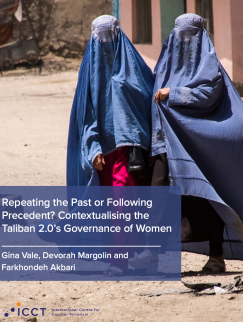
This paper examines how the Taliban’s return to power in Afghanistan (i.e., “Taliban 2.0”) has shaped its governance of women, situating current policies within a broader comparative analysis of governing violent Islamist groups. Drawing on primary statements and secondary sources, the authors compare the Taliban’s gendered governance practices with those of Da’esh (i.e., the Islamic State of Iraq and the Levant) and the violent armed group, Hamas, to assess how ideology, pragmatism, and legitimacy interact in contexts of violent extremism.
The analysis focuses on three dimensions of governance praxis: the implementation of gendered policies, the strategic utility of women to group objectives, and bids for domestic and international legitimacy. It shows how women’s bodies, roles, and rights are treated as instruments of governance and legitimacy, becoming central sites through which authority and authenticity are asserted, often resulting in the securitisation of women rather than their protection.
The paper concludes that the Taliban’s governance of women reflects continuity rather than reform, underscoring the tension between rhetorical moderation and persistent gendered exclusion, with serious implications for women’s everyday lives, social stability, and claims to legitimate governance.